
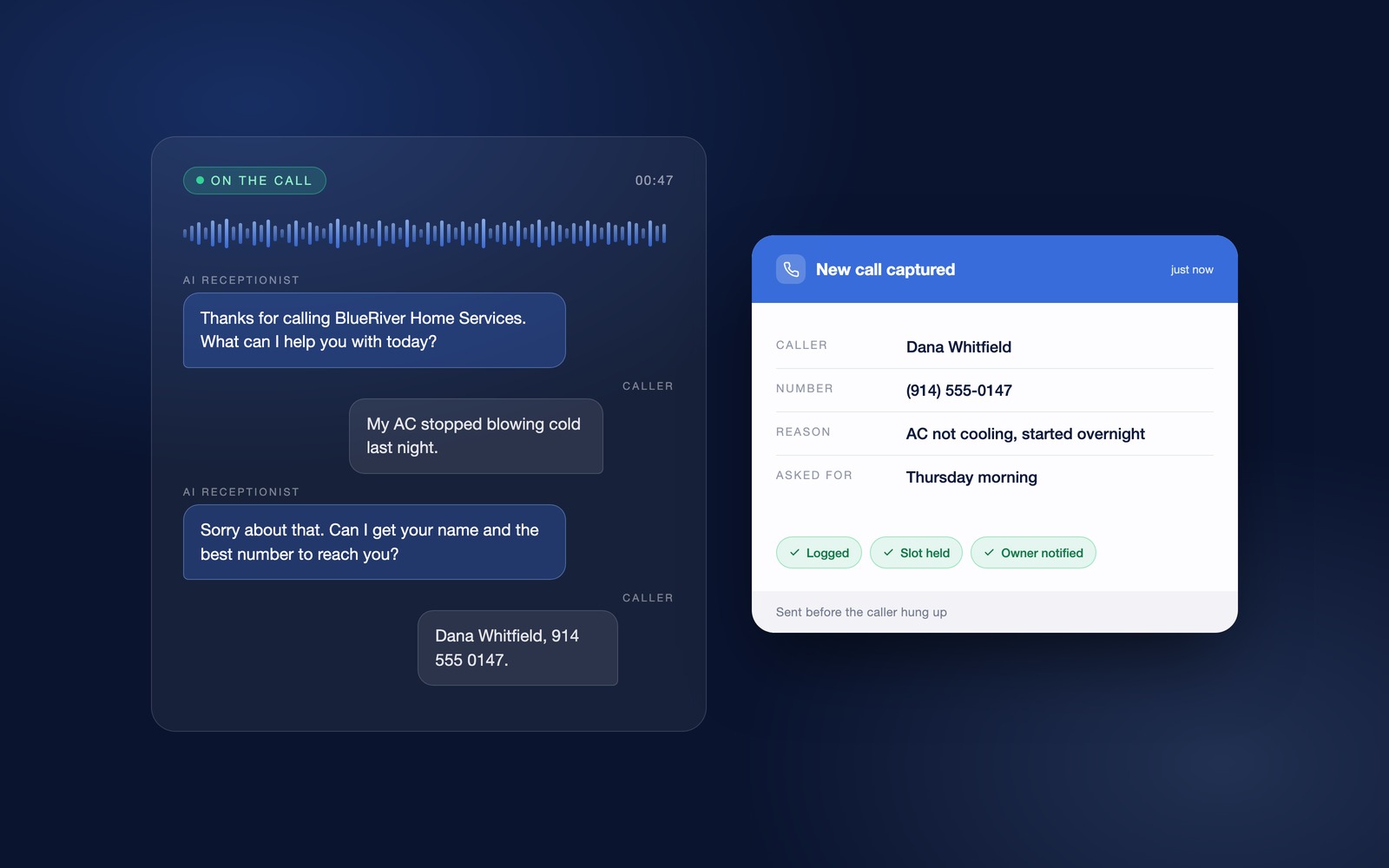
I build AI phone receptionists that act during the call. They answer when the front desk can’t, take down who’s calling and what they need, and lock the request in before the call ends, so the lead is never lost.
AI Voice Agents
What I built
- A live receptionist for a home services company that captures the caller’s name and reason and logs it to the owner before the call ends.
- A repeatable build system: a new agent gets generated from the business’s own website content, then grilled by simulated callers before any human dials it.
- A deployment architecture for medical offices where the published phone number never changes and patient details route straight to systems the practice owns.
- A call-handling rulebook earned from live test calls: transfer first on emergencies, never promise timing the office can’t keep, never hang up before the caller confirms.
A missed call at a local business is usually a lost customer.
Most small offices lose calls every day: the front desk is with someone, it’s Saturday, it’s 7pm. Voice AI demos incredibly well, but the demo is the easy part. The hard part is everything around it: callers who ramble, callers in pain, offices closed four days a week, a front desk worried about being replaced, and healthcare rules about where a patient’s information is allowed to travel. So the interesting work wasn’t the agent. It was the system around the agent.
Three layers between a ring and a booked job.
A receptionist that acts, not logs
Most voice agents record the call and someone reads a transcript later. Mine fires a tool call mid-conversation: while the caller is still talking, the request hits a workflow that writes it down and sends it out. By the time the caller says goodbye, three things have already happened, so nothing depends on the owner being free to pick up. I published the whole build as a free step-by-step guide.
Stress tested before anyone real calls
A demo agent is a few lines. A real one is a script with a branch for every way a call can go, plus hard rules it is never allowed to break. Then it goes through proper QA: scripted adversarial callers attack it before a single real customer does. The rambler, the price-demander who will not take no, the emergency, the person who just wants a human.
That testing round is where the rules come from. It caught an agent stuck in an infinite politeness loop, and another that read the details back and hung up before the caller could confirm them. Both would have been a client’s first impression. Now every build inherits the fixes: transfer first on an emergency, one step per turn, never promise a callback time the office can’t keep, and every refusal gets an escape hatch.
Safe enough for a medical office
For a dental, acupuncture or any medical practice, the architecture is the product. The published number never changes: the agent sits behind no-answer forwarding as an overflow destination, so nothing about how patients reach the office changes. Booking fills reserved slots the front desk never touches, so double-booking is structurally impossible without plugging into their scheduling software.
HIPAA is the part most voice demos skip. Patient details route straight into systems the practice already owns, never mine, and every vendor that touches them has to sign a BAA first. That single rule decides the whole stack, because the most convenient tools are often the ones that will not sign.
Free on the right plan, which is why the stack is built on these.
 Retell AI
 Vapi
Vapi
 n8n
n8n
 Claude Code
 Slack
Slack
 Twilio
 Google Workspace
 ngrok
ngrok